
FORGE AND CROWN EXTRA · BLOOD AND BELLOWS
Letters from the Forge
Hollis Ashford wrote to his daughter all through her first year at Camlough. Two of his letters appear in Blood and Bellows. These are three that don’t: his first, the full letter that came with the midwinter gloves, and one he never sent. The third is best read once you’ve finished the book.
I. Early autumn
Read the typed text
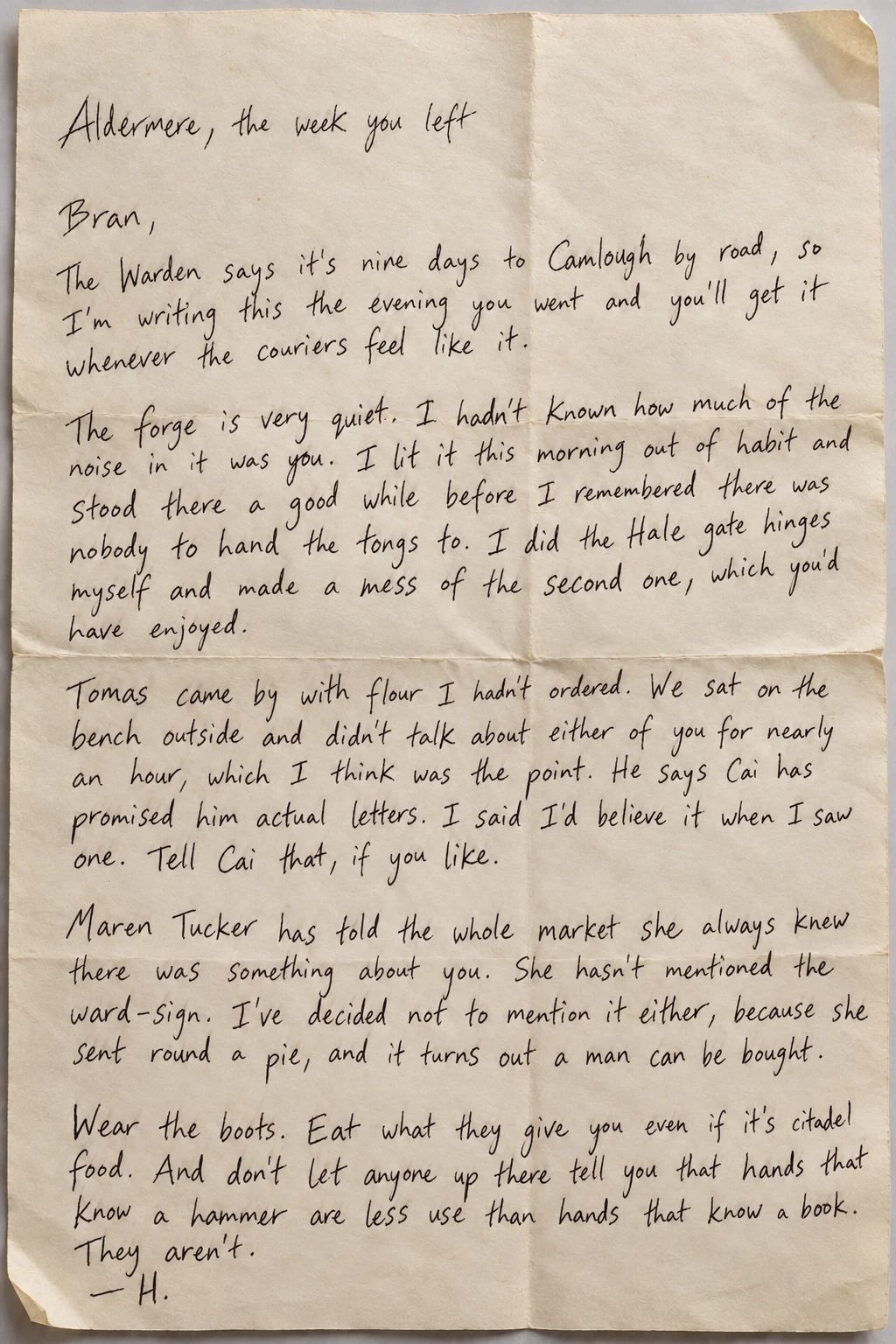
Aldermere, the week you left
Bran,
The Warden says it’s nine days to Camlough by road, so I’m writing this the evening you went and you’ll get it whenever the couriers feel like it.
The forge is very quiet. I hadn’t known how much of the noise in it was you. I lit it this morning out of habit and stood there a good while before I remembered there was nobody to hand the tongs to. I did the Hale gate hinges myself and made a mess of the second one, which you’d have enjoyed.
Tomas came by with flour I hadn’t ordered. We sat on the bench outside and didn’t talk about either of you for nearly an hour, which I think was the point. He says Cai has promised him actual letters. I said I’d believe it when I saw one. Tell Cai that, if you like.
Maren Tucker has told the whole market she always knew there was something about you. She hasn’t mentioned the ward-sign. I’ve decided not to mention it either, because she sent round a pie, and it turns out a man can be bought.
Wear the boots. Eat what they give you even if it’s citadel food. And don’t let anyone up there tell you that hands that know a hammer are less use than hands that know a book. They aren’t.
— H.
II. Midwinter
Read the typed text
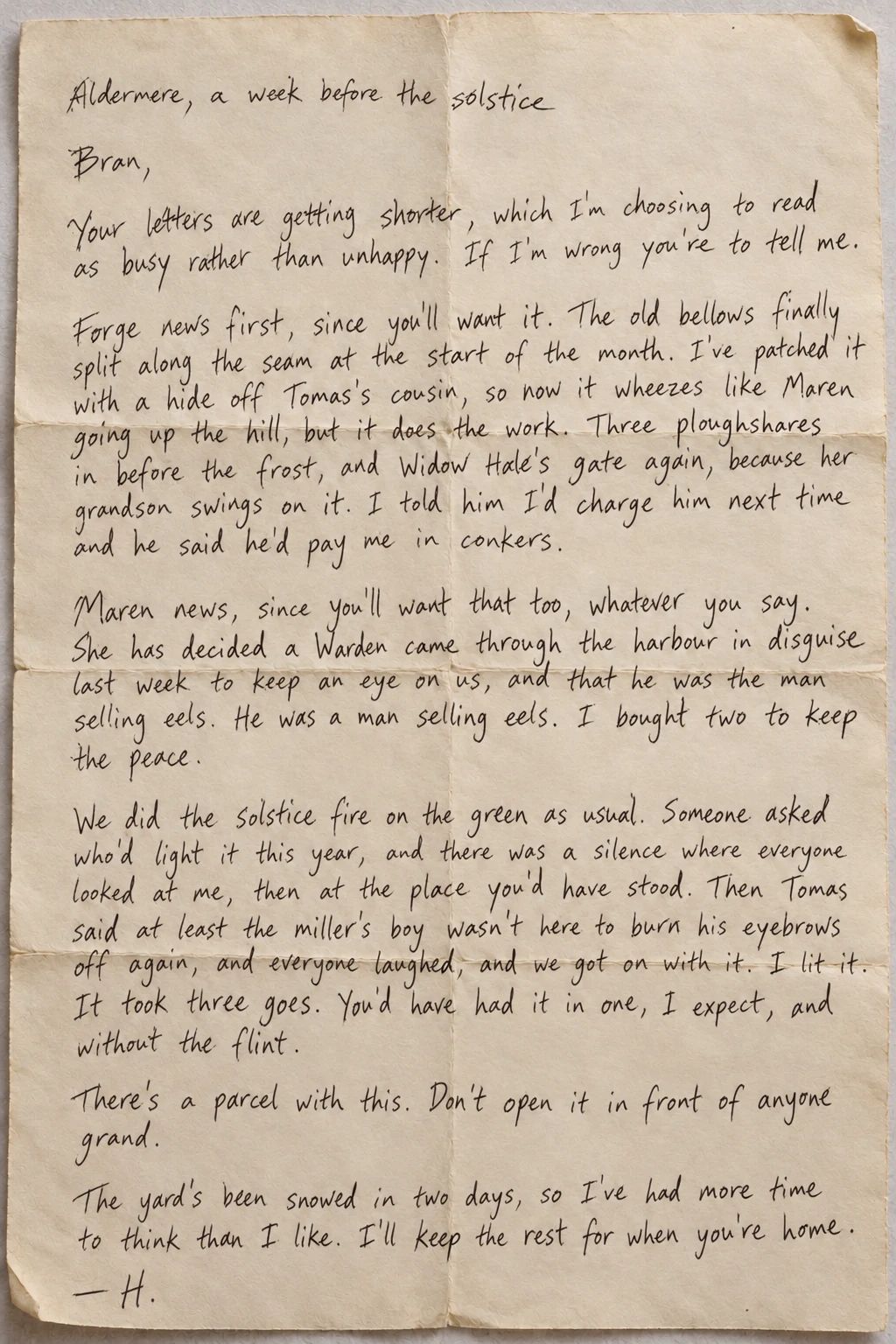
Aldermere, a week before the solstice
Bran,
Your letters are getting shorter, which I’m choosing to read as busy rather than unhappy. If I’m wrong you’re to tell me.
Forge news first, since you’ll want it. The old bellows finally split along the seam at the start of the month. I’ve patched it with a hide off Tomas’s cousin, so now it wheezes like Maren going up the hill, but it does the work. Three ploughshares in before the frost, and Widow Hale’s gate again, because her grandson swings on it. I told him I’d charge him next time and he said he’d pay me in conkers.
Maren news, since you’ll want that too, whatever you say. She has decided a Warden came through the harbour in disguise last week to keep an eye on us, and that he was the man selling eels. He was a man selling eels. I bought two to keep the peace.
We did the solstice fire on the green as usual. Someone asked who’d light it this year, and there was a silence where everyone looked at me, then at the place you’d have stood. Then Tomas said at least the miller’s boy wasn’t here to burn his eyebrows off again, and everyone laughed, and we got on with it. I lit it. It took three goes. You’d have had it in one, I expect, and without the flint.
There’s a parcel with this. Don’t open it in front of anyone grand.
The yard’s been snowed in two days, so I’ve had more time to think than I like. I’ll keep the rest for when you’re home.
— H.
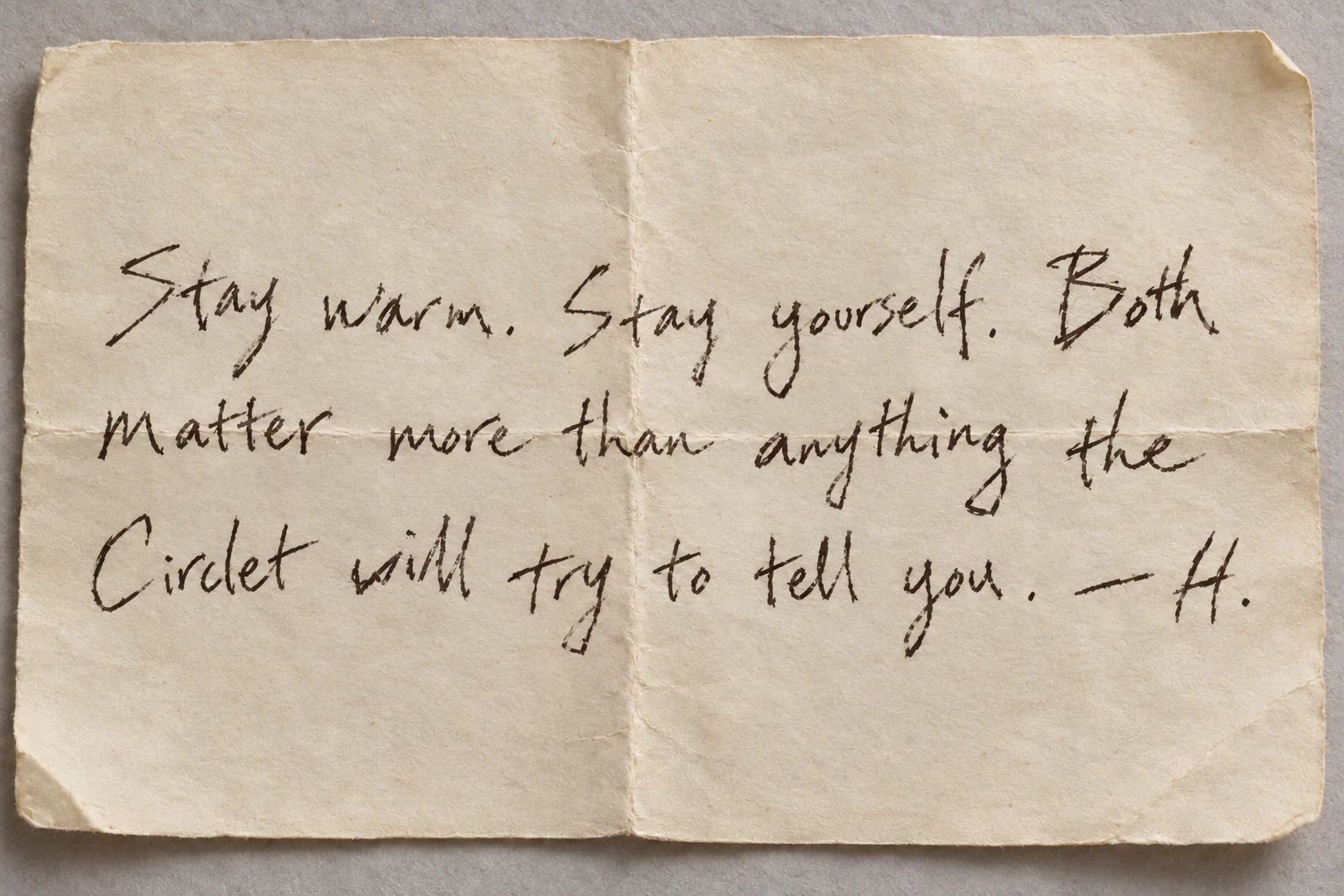
Folded inside the parcel, on a scrap of ledger paper:
Read the typed text
Stay warm. Stay yourself. Both matter more than anything the Circlet will try to tell you. — H.
III. Late winterLetter III is best read once you have finished Blood and Bellows. Open it when you are ready.
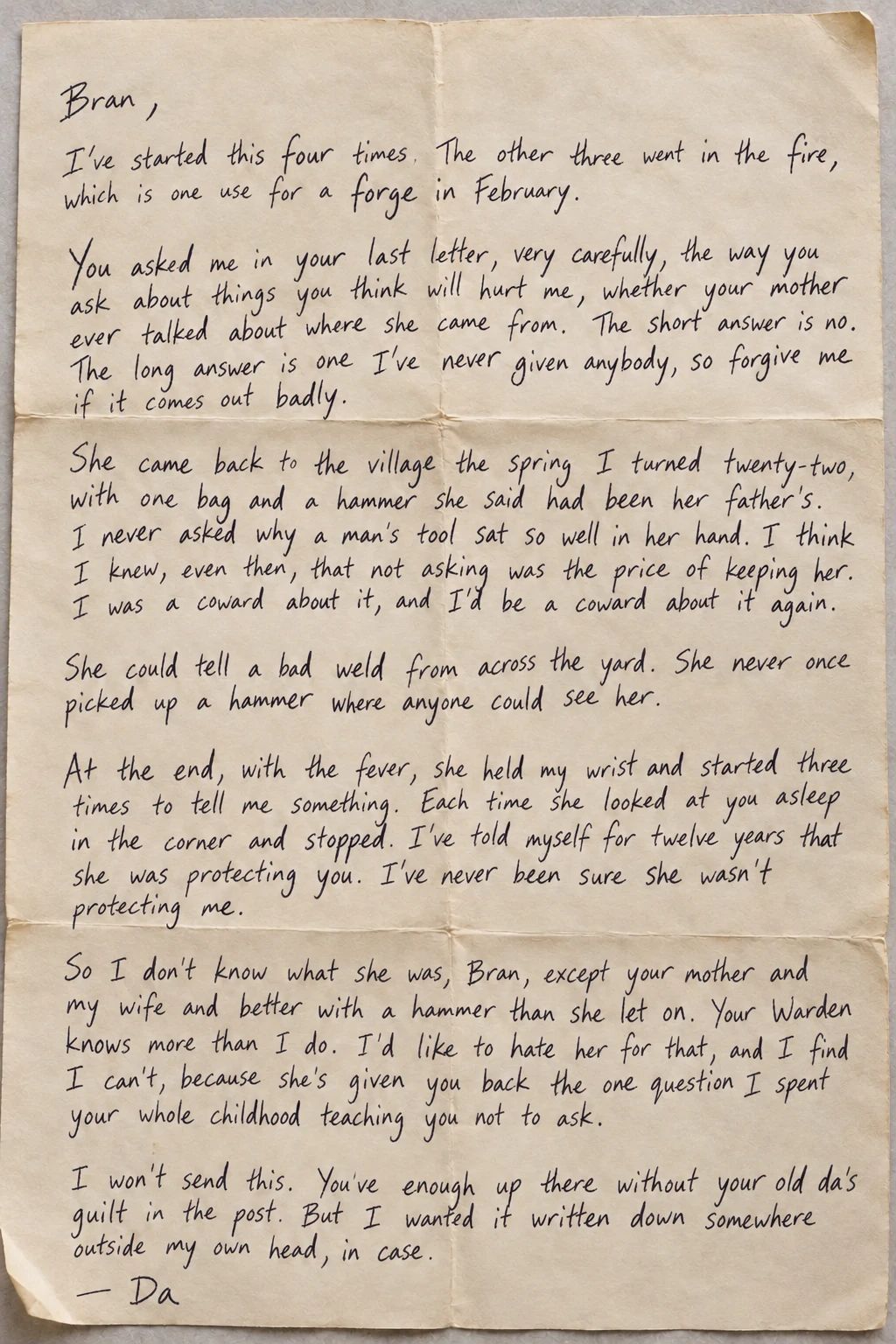
Found folded inside the back cover of the forge ledger. Never sent.
Read the typed text
Bran,
I’ve started this four times. The other three went in the fire, which is one use for a forge in February.
You asked me in your last letter, very carefully, the way you ask about things you think will hurt me, whether your mother ever talked about where she came from. The short answer is no. The long answer is one I’ve never given anybody, so forgive me if it comes out badly.
She came back to the village the spring I turned twenty-two, with one bag and a hammer she said had been her father’s. I never asked why a man’s tool sat so well in her hand. I think I knew, even then, that not asking was the price of keeping her. I was a coward about it, and I’d be a coward about it again.
She could tell a bad weld from across the yard. She never once picked up a hammer where anyone could see her.
At the end, with the fever, she held my wrist and started three times to tell me something. Each time she looked at you asleep in the corner and stopped. I’ve told myself for twelve years that she was protecting you. I’ve never been sure she wasn’t protecting me.
So I don’t know what she was, Bran, except your mother and my wife and better with a hammer than she let on. Your Warden knows more than I do. I’d like to hate her for that, and I find I can’t, because she’s given you back the one question I spent your whole childhood teaching you not to ask.
I won’t send this. You’ve enough up there without your old da’s guilt in the post. But I wanted it written down somewhere outside my own head, in case.
— Da